
Pilgrim Tales: The Story Behind “Faithful Journeys, Hidden Sanctuaries”
They stood in silence for a moment, the old man and the young, united by faith, by craft, by blood, and by the shared knowledge of what it meant to be touched by something beyond understanding. -“Faithful Journeys, Hidden Sanctuaries”
When invited to contribute to the CWG Anthology, I was happy for the opportunity to write a historical fiction story as a way to learn about the saints. In particular, a group of saints that we learned about while traveling through England this past winter.
We expected our visit to York to be about Yorkshire pudding and Vikings. Instead, we learned of the extraordinary courage of people who risked everything to practice their faith, the Forty Martyrs of England and Wales. Among them was Margaret Clitherow, the “Pearl of York,” a wife and mother who hid priests in her home and died under torture rather than betray them.
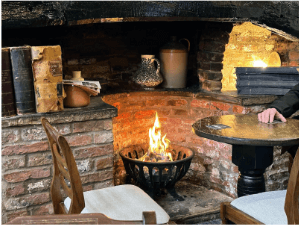
Our first stop was The Red Lion pub for lunch. Besides steak pie and real ale, this medieval pub featured a priest hole. Further research revealed the remarkable tale of Nicholas Owen, a carpenter whose genius for concealment saved countless lives through his construction of priest holes—those hiding places built into the walls, floors, and chimneys of Catholic homes during the persecution in Elizabethan times.
Bread oven circa 1300’s at The Red Lion pub in York. Photo credit: John Ruberto
These two figures captivated me, and I knew I wanted to honor them in fiction. But how do you tell this story? St. Margaret Clitherow held secret Mass at her home, protecting so many Catholics in York, and St. Thomas Owen, who operated in Oxford, built over one hundred priest holes across England before his death by torture in the Tower of London. They were separated by time and distance.
That’s when the pilgrimage tradition entered my imagination, to tie in another amazing experience traveling through Great Briton.
Our Lady of Walsingham had been England’s greatest pilgrimage site for centuries before Henry VIII ordered its destruction in 1538. What if a young Nicholas Owen—grieving, questioning, struggling with faith—journeyed to the ruins of Walsingham? What if that pilgrimage became the crucible where his calling was forged?
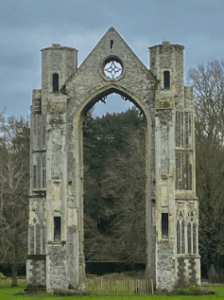
Remains of the Priory in Walsingham, once a great pilgrimage site in England.
Photo credit: John Ruberto
The resulting story follows a fictionalized Nicholas on a journey from Yorkshire to Norfolk, encountering Margaret Clitherow along the way. It’s a coming-of-age tale set against the dangerous backdrop of Elizabethan England, where celebrating Mass could cost you your life and harboring a priest meant death.
Through Nicholas’s eyes, we see how pilgrimage—even to a destroyed shrine—can transform a heart. We witness how grief can become purpose, how craftsmanship can become ministry, and how ordinary people become saints not through grand gestures but through faithful, hidden service.
“Faithful Journeys, Hidden Sanctuaries” appears in the anthology Pilgrim Tales, celebrating the tradition of Christian pilgrimage through fiction. It’s my small attempt to remember those who built secret sanctuaries and kept the faith alive through England’s darkest era.
John Ruberto and his wife, Laura, write about their pilgrimage experiences on their blog, The Hallowed Way.
Read “Faithful Journeys, Hidden Sanctuaries,” and other short stories by the Catholic Writers Guild in Pilgrim Tales: a Catholic Writers Guild Short Story Anthology available now on Amazon in print and e-book.
Feature Photo by John Ruberto
© Copyright 2026 by John Ruberto
Edited by Rietta Parker
- Pilgrim Tales: The Story Behind “Faithful Journeys, Hidden Sanctuaries” - January 27, 2026

 Image by Karolina Grabowska from Pixabay

Leave a Reply
Want to join the discussion?Feel free to contribute!