 Attribution: Joe King, CC BY-SA 3.0
 Lawrence, Lorenzo, and Lorcán
Lawrence, Lorenzo, and Lorcán
The Roman Catholic Church has canonized at least three very different holy men who are all known, in English, as St. Lawrence.
The name that they share is derived from a Latin word, Laurentium, and goes back even further in history to an Old Greek name, Lavrenti (1). The Latin place name is thought to refer to a grove of Laurel trees.
Both Greek and Roman mythologies document that groves of laurel trees were regarded as sacred in these cultures, where a crown of laurel leaves was bestowed on the victors of various competitions in sports, dance, music, and poetry (2).
Mother Church has determined through her process of discernment for canonization that all of these three St. Lawrences have indeed won their crowns of eternal life.
They were born with unique gifts, into different cultures and historical circumstances, and each of them served different roles during their lives on earth.
St. Lawrence of Rome, 225-258, Deacon, Canonized “pre-Congregation”

The Martyrdom of St. Lawrence of Rome, Peter Paul Rubens, 1614
American Catholics might most readily recognize as “St. Lawrence” the Roman Deacon made famous in hagiographic stories about his humor while outwitting an emperor, and while undergoing martyrdom on a roasting grill.
The stories of St. Lawrence’s distribution of Church valuables to the indigent of Rome, and his presentation of the Christian people to Emperor Valerian as “the wealth of the Church,” are believed to be reliable (3).
But one historian has challenged the roasting story, claiming that it stemmed from a transcription error in the written records, and suggesting that St. Lawrence, the Deacon of Rome, was more likely beheaded in 258, soon after his friend, Pope Sixtus II experienced the same martyrdom. (4)
Deacon Lawrence’s bountiful service to the poorest people of his time, and his saintly courage in the face of martyrdom (by whatever means), are undisputed. These heroic qualities are recognized in his Feast celebrated on the United States liturgical calendar each August 10. (5)
San Lorenzo de Brindisi, Order of Friars Minor Capuchin, 1559-1619, Canonized 1881, Doctor of the Church, 1959
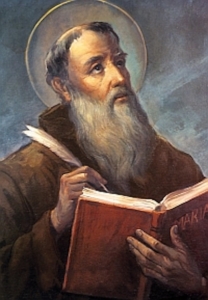
St. Lorenzo of Brindisi, Doctor of the Church.
Our easier recollection of the earliest “St. Lawrence,” above, may in part be due to the fact that the saintly incandescence of August, while still blinding, appears to be slightly less overwhelming than it is in this month of July.
From St. Junipero Serra, patron saint of Serra International, the Vatican apostolate for vocations, who began the month on July 1, to St. Ignatius of Loyola, creator of the Spiritual Exercises and founder of the Society of Jesus, who completes it on July 31, the list of Roman Catholic Saints who are liturgically honored in July is replete with luminaries (6).
It would be so easy to overlook the Optional Memorial for San Lorenzo de Brindisi, who also is known in English as St. Lawrence, on July 21.
Father Butler’s Lives of the Saints reports the historical date of his death as July 22. His Feast Day in the pre-Vatican II liturgical calendar, was also celebrated on July 22. Butler describes San Lorenzo as a “Confessor” (7). The 2025 USCCB liturgical calendar now describes St. Lawrence of Brindisi as “Priest and Doctor of the Church.” (8)
Born Guglielmo (or Guilio) de Rossi (or Russi) in the Kingdom of Naples, to a Venetian merchant family, he was gifted by God with an exceptional abundance of talents. (9)
Documented as a prodigy from early childhood, he presented popular narratives about Baby Jesus during the Christmas festivities in Venice, and was already recognized for his oratorical gifts. He began his formal studies at St. Mark’s college when he was 12 years old.
He was called to preach the Venetian Lenten sermons while still a deacon, and completed his advanced studies at the University of Padua. He was ordained a priest at the age of 23. He joined the Franciscan Capuchins as Brother Lorenzo, and was elected a provincial superior by the time he was 31. (9)
A genuine linguistic polymath, St. Lawrence of Brindisi read, wrote, and fluently spoke in Hebrew, Greek, Latin, and all of the European languages of his time. He memorized the entirety of the Bible. (9)
His lifetime production of written works numbered eight volumes of sermons, two treatises on oratory, a commentary on Genesis, a commentary on Ezekiel, and three volumes of religious polemics. (9)
He served as chaplain of the Imperial army in the immediate aftermath of Christian victory at the Battle of Lepanto. Victories against the Turks that defied all odds in the subsequent land battles were attributed to his intercession. (9)
San Lorenzo was sent throughout the known world of his time as an evangelizer, and as a diplomat to settle constant disputes among princes, during one of Europe’s most turbulent centuries. (9)
Despite his retirement to a respite of welcome spiritual contemplation at the end of his life, he did not refuse one last request to undertake yet another arduous sailing voyage to Spain. His death resulted from the fatigue caused by that final diplomatic mission. (9)
Lorcán Ua Tuathail, 1128-1180, Canonized 1225
Most of us in the United States might not even recognize this name in Irish Gaelic, and only a few might have heard of him as St. Lawrence O’Toole. Unless I failed to find it, his memorial does not appear in the USCCB liturgical calendar for the United States.
But the November 14 Feast of this influential twelfth-century Archbishop of Dublin, and that city’s enduring patron saint, is still celebrated with great affection in Ireland today. (10).
He was born in County Kildare, where his father was chief of Hy Murray. According to the custom of the time, Irish politics required that Lorcán, as the chief’s son, be sent as a “guarantee hostage” to the King of Leinster. (11)
Leinster’s monarch treated the child with such abuse that “…his father obliged the King to turn him over to the Bishop of Glendalough…” (11)
St. Lawrence O’Toole was elected the new Abbot of lake-and-forest monastery Glendalough, founded by hermit St. Kevin, by the youthful age of 25. (12)
He served the monastery as Abbot until he was called to the See of Dublin in 1161, to become its second Archbishop (11) at a time when cultural conflicts between the indigenous Irish and newly arriving Norman settlers had become particularly contentious (12).
The story is told that St. Lawrence O’Toole was attacked by a terrorist while approaching the altar at the court of King Henry II of England. He asked for water, blessed it, and applied it to what all the witnesses present had believed was a mortal wound. The bleeding stopped immediately and the Archbishop carried on to celebrate mass (11).
On November 14, 2019, Archbishop Diarmuid Martin, in his address celebrating two retiring Bishops in the Archdiocese of Dublin, recalled the many accomplishments of this great Irish saint. (12)
Archbishop Martin also noted that St. Lawrence O’Toole had “…attended the Third Lateran Council in Rome in 1179, at a time when travel across Europe was perilous…” (12)
St. Lawrence O’Toole died in France just one year later, on another diplomatic journey, to attempt yet again a lasting peace with the Normans. (12)
He is the only St. Lawrence who speaks directly to readers in Ronda de Sola Chervin’s 20th century book, Quotable Saints.
“My Will! What are you talking about? Thank God, I haven’t a penny left in the world.” (13)
St. Lawrence of Rome, San Lorenzo de Brindisi, St. Lawrence O’Toole,
Pray for us.
© Copyright 2025 by Margaret King Zacharias
Notes and Sources
- https://en.wikipedia.org/wiki/Saint_Lawrence#cite_note-Healy-11
- https://bible.usccb.org/bible/readings/081024.cfm
- Butler, Rev. Alban, Lives of The Saints: With Reflections for Every Day in the Year, New Edition, New York, Boston, Cincinnati, Chicago, San Francisco: Benziger Brothers, Inc., “Printers to the Holy Apostolic See”, 1955, pp. 408-409
- https://bible.usccb.org/bible/readings/072125.cfm
- This information is based on its primary source https://en.wikisource.org/wiki/Catholic_Encyclopedia_(1913)/St._Lorenzo_da_Brindisi
And
and
https://www.catholicireland.net/retirement-two-bishops-ordination-deacon-mass-dublins-patron-saint/
- https://www.catholicnewsagency.com/saint/st-lawrence-otoole-53
- https://www.catholicireland.net/retirement-two-bishops-ordination-deacon-mass-dublins-patron-saint/
- Chervin, Ronda De Sola, Quotable Saints, Ann Arbor, MI, Servant Publications, 1992, p. 106.
Image credits:
Feature Photo: Glendalough, Early-Medieval Monastic Complex, Wicklow, Ireland
Attribution: Joe King, CC BY-SA 3.0 <https://creativecommons.org/licenses/by-sa/3.0>, via Wikimedia Commons
The Martyrdom of St. Lawrence of Rome, Peter Paul Rubens, 1614
Attribution © José Luiz Bernardes Ribeiro
This file is licensed under the Creative Commons Attribution-Share Alike 4.0 International license.
St. Lorenzo of Brindisi, Doctor of the Church
Attribution: https://www.cappuccinivenezia.org/spirito.htm, Public domain, via Wikimedia Commons