
“Un poco a riso”: The Joy of Dante’s Purgatorio
Last spring, in my final semester of my undergraduate studies, I covered the medieval period requirement of my literature program with a study of Dante. The Divine Comedy was a truly fulfilling way to finish out my three-year liberal arts degree. Dante’s incomparable work is a most shining example of literature’s interdisciplinary potential. One cannot study the literature of the Comedy without touching upon history, languages, philosophy, and theology. Dante, and literature in general, can be both a gateway into the other disciplines and a rewarding treasure that is available once the others have been studied in depth. Studying Dante in the semester in which I did, with a wonderfully mixed group of third- and fourth-year students, I was amazed at the beautiful intersection of all disciplines. Students majoring in history, Classical studies, or the theology buffs all brought great insight to the table because Dante has something for everyone.
I digress. Dante’s work is a rich harvesting ground for scholars, but my purpose is to appreciate his relevance for the Lenten pilgrim.
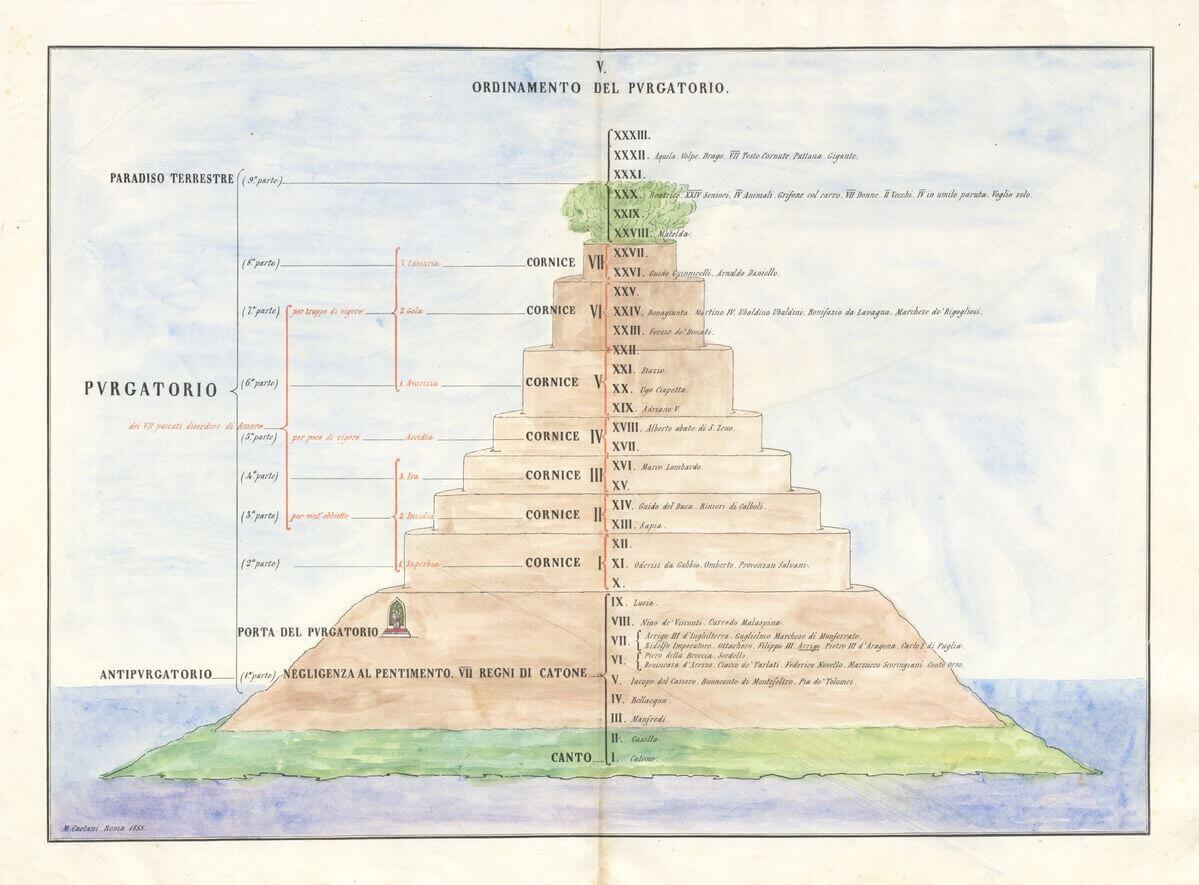
Having thoroughly enjoyed my semester with Dante, but mindful of the enduring value of the Comedy after many readings, I took up the Purgatorio again as a Lenten pilgrimage through holy purification for the soul. There is much to be gleaned from the depictions of sins and their various cures, but a few aspects of the work stood out in particular as fitting meditations in the season of Lent. The physical imagery and structure of the Mountain of Purgatory, with its seven levels – or “cornices” – corresponding to the Seven Deadly Sins, gives a wonderful and memorable visual depiction to help one tackle sin in real life.
First, and this is fitting to this Fourth Sunday of Lent – known as Laetare Sunday – Dante’s depiction of Purgatorio is touched with a deep sense of joy and peace. Be assured, there is much penitential sorrowing and prayers for mercy and forgiveness, but the attitude of the suffering souls is one of resignation to the saving work of purification, and a levity of spirit because they are assured of ultimate bliss in heaven. Near the end of Canto IV, Dante recognizes a soul among those in Ante-Purgatory (a sort of holding space before entering into the cornices of Purgatory proper) and smiles, saying, “no longer need I grieve for you” (Purgatorio IV.123). Dante has found his friend, one whose life had not been the most virtuous, in Purgatory, and this is cause for joy, despite the suffering and purification that still await him.
True, the suffering souls still yearn for heaven’s bliss; they are incomplete without it, but the souls in Purgatory are safe from eternal damnation. They may be sure that their suffering has a definite endpoint, and their deepest longing will ultimately be fulfilled. The souls one encounters in reading the Purgatorio brilliantly contrast with those of the Inferno in their willingness to undergo suffering, singing and praying to God throughout the experience.
We, of Church Militant, might share the Suffering Souls’ joy in penitence. While our Lenten days can be tedious and painful, we can rejoice to know there is merit in suffering and that we might draw closer to God through the discomfort. We rejoice on Laetare Sunday to know that the end is in sight – that resurrection and redemption are at hand for us, as heaven is at hand for those climbing Mount Purgatorio.
Another aspect of Purgatorio which might serve one well on the Lenten pilgrimage is the use of Marian example as an encouragement against vice. Pride is combatted by the humble “Fiat” of the Annunciation; Sloth is rebuked with the reminder that Mary went in haste to visit her cousin Elizabeth; Lust is chastened with the Virgin’s words “I know not man”, to name a few. Prayer through meditation on our Blessed Mother is a powerful practice for both Purgatorial and Lenten pilgrimage. Of course, as Dante will show, mediation can also take the via negativa route, considering biblical examples of those who espoused vice rather than virtue. Both have a place – both can be beneficial in curing a soul of vice.
A final lesson one might take from Purgatorio and apply to the Lenten pilgrimage is the value of communal prayer, in union with the prayer of the Church, as a cure for human sinfulness. At each cornice of the Purgatorio, and even in the less structured realm of Ante-Purgatory, the souls are found in prayer together. In the specific cornices, the prayers are pointed and aimed towards conversion from the sin addressed in that area. Perhaps Dante’s selection of prayer for each sin could act as a meditative guide for readers fighting the seven sins represented in the purgatorial cornices! But, more importantly, Dante portrays the souls in Purgatory as incorporated into the prayer of the Church – the same prayers as should be familiar to those steeped in Catholic tradition. In our Lenten journey, much as the souls who seek purification after death, we must certainly depend upon the prayers which Holy Mother Church has handed on to us to be prayed in communion with our brothers and sisters.
So, let my encouragement to you at this mid-lent point be to take up Dante’s Purgatorio for yourself and find therein some inspiration for these last weeks of your pilgrimage. And, as writers, let us endeavor to steep ourselves in the wisdom of many disciplines, but most especially in the wisdom of our Faith, for inspiration in our writing.
May we each draw closer to God through our Lenten penitence! And, may the Souls of the Faithful Departed, through the mercy of God, rest in peace!
Copyright ©️ 2026 Maggie Rosario
Edited By Janet Tamez
- Molly Chase: An Inspirational Work of Catholic Literature - May 17, 2026
- “Exult, let them exult”: The Church in Paschal Celebration - April 19, 2026
- “Un poco a riso”: The Joy of Dante’s Purgatorio - March 15, 2026


Leave a Reply
Want to join the discussion?Feel free to contribute!